Blog
Curator’s Guide to Color Block
Since early September, VisArts’ True F. Luck Gallery has been filled with joyful and colorful works by Maine-based artist, Eleanor Anderson. Color Block features Anderson’s recent fused glass panels (created during her residency at VisArts) alongside her ongoing series of mixed-media textile tapestries. Now in its final week on view, this is your last chance to catch the exhibition at VisArts. Whether you attend Color Block: In Motion on Friday evening or stroll through the gallery this weekend, we know you’ll want to get the most out of your visit! We chatted with the show’s curator, Haley Clouser, to learn more about her unique perspective on the exhibition and to help enhance your experience.
VisArts: What do you think viewers should know before coming to enhance their experience?
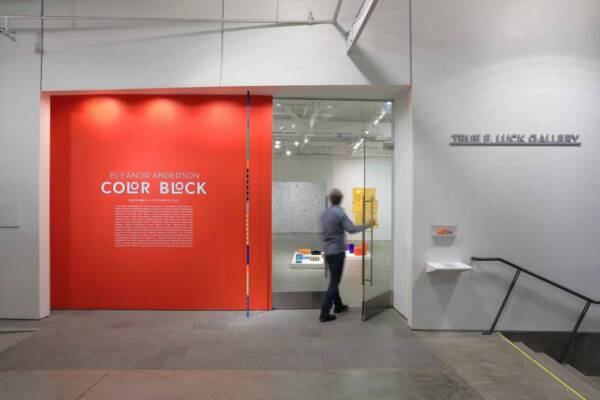 Haley Clouser: The beauty of Eleanor’s work is that its entry points—the visual “hunt” and the bodily experience—allow visitors to engage with her works without any prior knowledge, making it accessible to all. At the same time, an awareness of certain art historical contexts can deepen the experience. Eleanor’s bold color palettes, geometric and linear compositions, and emphasis on materiality resonate with the Minimalist movement of the 1960s and with approaches associated with “craft” art. While these movements are not direct inspirations, viewers may notice throughlines to work by Modern artists such as Alan Shields, Fred Sandback, and Donald Judd. Her focus on colorful, decorative detail, meticulous craftsmanship, and experimental use of materials also echoes the practices of “craft” artists like Harmony Hammond, Sheila Pepe, and Polly Apfelbaum. Background reading on 1960s Minimalism or the work of these referenced artists can provide additional layers of insight, though the work remains fully engaging without it.
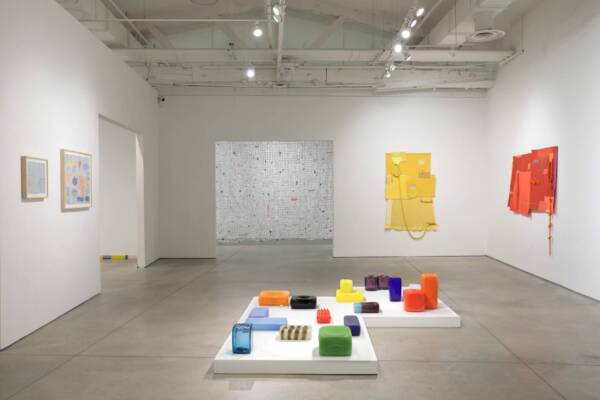
“Color Block,” photographed by David Hale.
Which artwork should be visitors’ first stop in the gallery?
Every work in the space was placed with intention, so the glass boxes at the gallery’s entryway serve as the first stop. Glass was what initially drew Eleanor to VisArts’s residency program and remains a medium consistently present across all the galleries, making this series both a fitting introduction to the show and inspiration for its title. Reminiscent of children’s toy blocks, this series not only showcases Eleanor’s adventurous experimentation with materials such as glass, but also sets the stage for the exhibition’s broader themes of play and connectivity. Glassmaking is a collaborative discipline, requiring multiple gaffers to work together, and is a space that demands an acceptance of breakage or “failure,” where risk is safe and trying again is integral. To Eleanor, these qualities she found in glassmaking are the very “prerequisites of play.”
What struck you about Eleanor’s work the first time you saw it?
Her keen sensibility to balance texture, color, and scale within each composition. One of the greatest challenges for any artist is recognizing when a piece is complete, a decision that often requires restraint and awareness of compositional weight. Eleanor’s approach both honors and subverts this principle, testing the limits of what can be introduced in pursuit of what she calls “maximizing the minimal,” without tipping into excess.
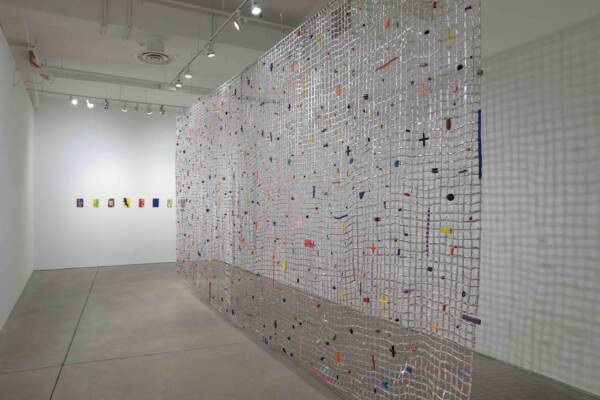
Eleanor Anderson, “Silver Lattice,” 2025.
What’s something special that visitors should pay attention to when exploring the exhibition?
The sight lines are especially striking. As you move through the side and back galleries, the works guide your gaze upward, downward, and across, drawing attention to how they interact with and “fit” within the gallery’s architecture. A particularly beautiful moment happens in the back gallery with Silver Lattice, where the piece casts a gridded shadow onto the floor and wall, echoing the ways the Poles series and Lane Lines similarly bridge together walls, floors, and ceilings through line. Both the physical space and the way the eye moves through it were carefully considered for this show!
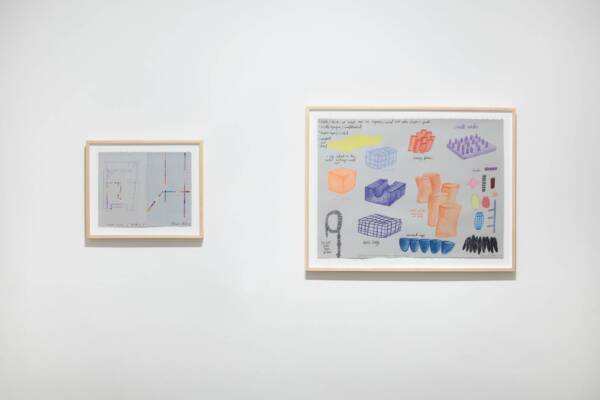
Left: Eleanor Anderson, “Lane Lines & Poles I–VII,” 2025. Right: Eleanor Anderson, “Sketches for Pilchuk and Museum of Glass Residency,” 2025.
Tell us more about Lane Lines & Poles I-VII (the floorplan of the gallery). What’s the story behind including this in the exhibition?
In one of our early conversations, Eleanor shared drawings in which she sketched ideas for the glass sculptures, a version of which now appears in the exhibition. Because process lies at the core of her practice, we discussed including some of these preliminary sketches as a way to pull back the curtain and illuminate the steps leading to the finished pieces.
At the same time, we were developing the exhibition’s layout, a document mapping the placement of works on the gallery floor plan through the architectural software SketchUp. While conceptualizing the display of Lane Lines and the Poles series in this digital model, Eleanor created her own concept drawing using the gallery floorplan. Playful in tone and rich in linework, these drawings extended the show’s themes and echoed its compositional language.
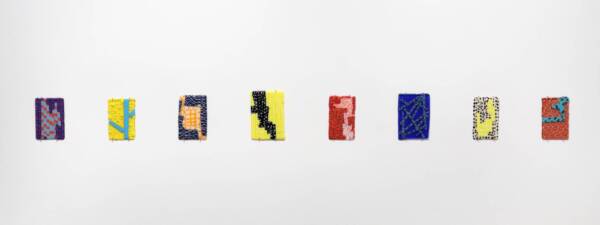
Fused glass panels created during Anderson’s residency at VisArts in April 2025.
What was your favorite part of working on this exhibition?
Learning more about the glassmaking process through Eleanor’s own experimentation with the medium. As a curator, one of the best ways to understand a discipline is by working directly with an artist practicing in it. Since relatively few artists work in glass, I was particularly excited to explore its possibilities through Eleanor’s practice, including its versatility in combination with other media such as fibers and textiles.
About the Curator
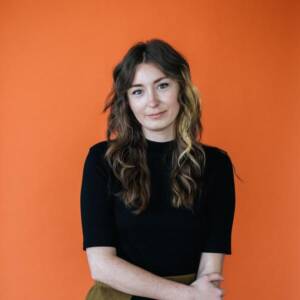 Haley Clouser is the Assistant Curator at the SCAD Museum of Art (SCAD MOA) and an independent curator and writer. At SCAD MOA, she has curated and supported exhibitions including Raul De Lara: Raíces/Roots (2025), Iván Argote: The Burden of the Invisible (2024), and Tyler Mitchell: Domestic Imaginaries (2023). Previously, she was the Curatorial Fellow at deCordova Sculpture Park and Museum, where she organized exhibitions with artists such as Rachel Hayes, Carolina Caycedo, and Melvin Edwards. In 2020, she received the Samuel H. Kress Foundation Fellowship to support American Land, American People at the Virginia Museum of Fine Arts, where she also contributed to the landmark exhibition The Dirty South (2021), as well as gallery rotations, acquisitions, and special projects. Her independent curatorial projects have been supported by the National Endowment for the Arts and the Andy Warhol Foundation, and her writing has appeared in BURNAWAY, The Boston Art Review, IMPACT Magazine, and other publications. She holds an MA in Art History from Virginia Commonwealth University, and lives and works in Savannah, GA.
About the exhibition
Color Block
Eleanor Anderson
September 5 – October 19, 2025
Free + open to the public | Open daily 9am – 9pm
Visual Arts Center of Richmond’s True F. Luck Gallery
1812 W Main St, Richmond, VA 23220