Blog
A conversation with Artist-in-Residence, Luis Vasquez La Roche
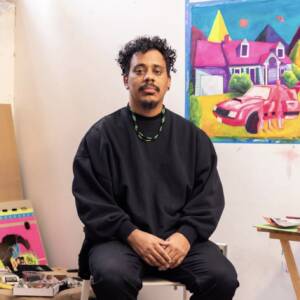
Luis Vasquez La Roche (he/they) is one of the Visual Arts Center of Richmond’s 2024–2025 Annual Residents. Luis is an interdisciplinary artist whose work delves into performance, sculpture, video, drawing, and most recently, painting. Their work explores aspects of the transatlantic slave trade that continue to repeat themselves in varying ways in the present. Much of Luis’ work is also inspired by conversations with their mother.
Nearing the end of their residency, we caught up with Luis in their studio to learn more about their art practice, their experience here at VisArts, and their recent expansion of their practice into painting.
VisArts: Luis, how would you describe your creative practice?
Luis: I think what’s really at the core of my practice is conversations with my mother.
Back in 2015, I found Trinidad’s registry of enslaved people, and I found our last name: La Roche. According to oral tradition in Trinidad, everybody who has the last name La Roche is related. In the early 1900s, there was a fire in Trinidad that destroyed all the records, so there’s a huge gap.
I’ve been trying to find my way back to that name through other things: through painting, through histories, through stories that I hear from families. You go to very specific places on the island and you’ll hear stories that the grandfathers or the great-great-grandfathers told their kids. All these people who live in this island of Trinidad, we’re all examples of how things like the transatlantic slave trade, or capitalism, or colonization affects people. We’re affected by it generationally. I use the example of my mother and myself as one example of what can be a story of many stories that are kind of replicated in other places.
I also try to do the research through paint and other materials, like cotton or sugar or palm oil, trying to look through history. I’ve been dabbling with any material that’s related to the slave trade.
Tell us more about these materials.
When I initially found that name in the slave registry, I was doing a lot of drawing around that time. I tried to start drawing with palm oil. I was doing a lot of tests, trying to add the word “negro” onto paper, which is the word that we use for Black in Spanish. I was initially trying to use paper to kind of make this word exist in a certain way, but then the paper itself absorbed the palm oil. The text gets bold, then it spreads, and with the passing of time, the palm oil fades and becomes clear. I thought it was really funny since I was trying to make something visible, and then the thing just disappeared into the paper.
One of my professors in graduate school told me, “I think the extra material here is paper. If you take the paper away, what do you what do you have left?”
I was like, “Well, the palm oil.”
He said, “Yeah, figure it out.” [Laughs.]
If you think about art as being this thing that is not made for someone like you, why are you even using paper in the first place? That’s how I enter performance, by removing paper and just exploring the material on its own.
During your residency here at VisArts, your practice seems to have shifted to engage more with drawing and painting. Tell us about this.
My practice has been so impermanent in a way, and I’m interested in things disappearing. We in the Caribbean, we were never treated as real people—especially what’s happening right now in the present.
I feel within the history of painting, obviously at a very specific time, it was all about power, well-known people, their last names. I don’t want these paintings to mimic that for me. In Trinidad, most of the population is Black, and half of the population is from Indian descent. We have this view that art was never meant to be done by people like us. I think it’s interesting to think about photography or painting—something so permanent. What does it look like to create a subject that references the Caribbean? Am I meant to be in a painting?
I’ve never been interested in realism, and I’m not interested in an abstraction either. But I’m interested somewhere in between there, in between that space of fantasy surrealism, because I feel like that’s what the Caribbean feels like. It feels like a surreal, fantastic place that it doesn’t exist in nobody’s reality in a certain way. Sometimes I tap into these fun, colorful, carnivalesque ideas.
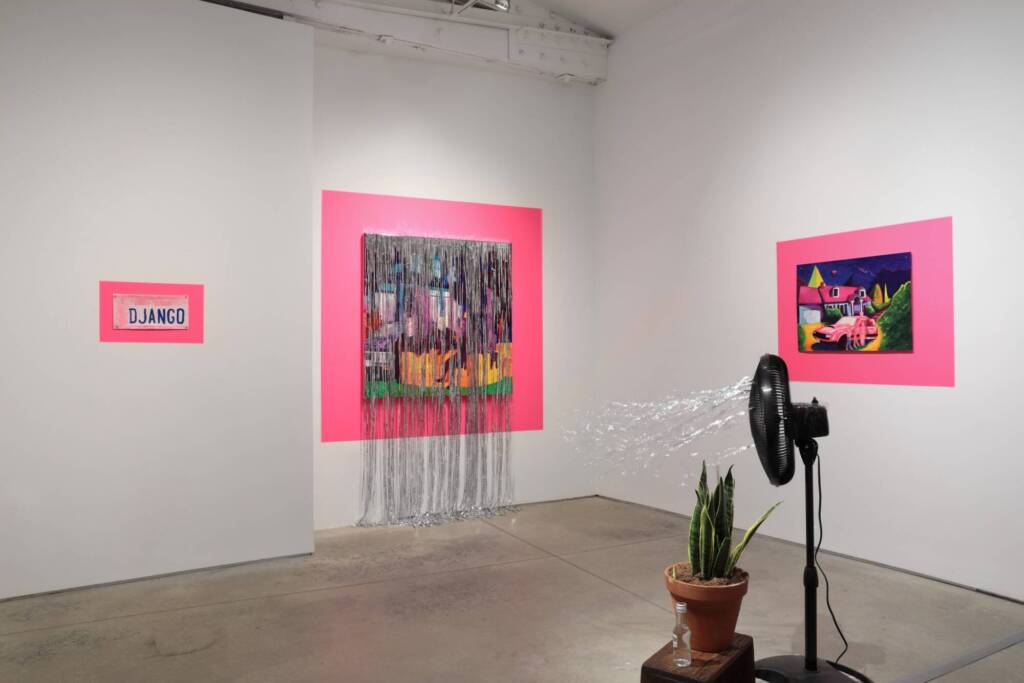
“What We Share” on view in the True F. Luck Gallery, May 2025
I used to talk a lot of trash about painting. I hated it. And part of the reason why I disliked painting so much was because most of the paintings of the Caribbean were those tourist scenes, where everybody comes to the Caribbean to kind of like extract from it. It’s taken me a long time to appreciate painting.
I feel that painting for me has an extension into performance, and it has an extension into sculpture and even video. I also like being here at VisArts with so many people that paint. It’s also really beautiful, for example, to meet Davi [Leventhal, former VisArts Studio Access Resident] and every time that I’m here having a hard time, I would just kind of like pop out of my studio and find him to ask questions about painting.
What was something you experienced during your residency that you weren’t necessarily expecting?
These social interactions, the conversations. Also, the wonderful other annual residents, Doah, Evie, and April, and seeing the similarities and the differences between our practices. For example, Evie is also making a lot of cast work. When I saw some of Evie’s sculptures, I was like, “Whoa, this is so surreal, I wish I came up with it!” [Laughs.] I feel like those things for me are always so beautiful—when you’re surrounded by people that make things that blow your mind.
Interests and opinions expressed by artists-in-residence are their own. Learn more about VisArts’ organizational values and code of conduct.