Blog
A conversation with Writer-in-Residence, April Sopkin
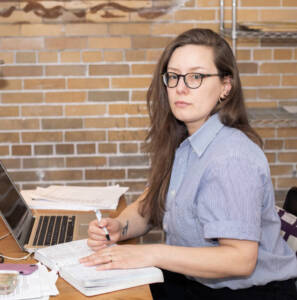
April Sopkin (she/her) is one of Visual Arts Center of Richmond’s Annual Residents. April writes fiction and personal essays, and even dabbled with some sculpture work for the Annual Resident exhibition, What We Share.
Nearing the end of her residency, we caught up with April in her studio to learn more about her writing practice and her experience here at VisArts.
VisArts: Do you remember what first drew you to writing?
April: What first drew me to writing was reading. I wonder if there’s another way to get into it, you know? I was just a voracious, obsessive reader. It started with not The Baby-Sitters Club, but the younger versions called the Baby-Sitters Little Sister series by the same author, Ann M. Martin. I did a hard turn from there, and I got straight into horror. I read a lot of Goosebumps by R.L. Stine. I was reading whatever was popular for young kids at the time, and I’ve been writing since before I can really remember. My mom always remembers me doing it, and I just have these atmospheric, vague memories of sitting at my dining table and writing in a three-ring notebook. When I was really little, I would write a lot of stories about girls with great hair and things like that [laughs]. I would get obsessed with certain names like Viola and Brie. But yeah, I would be just writing at my dining room table growing up.
What have you been working on during your time here at VisArts?
So, I write short fiction, mainly. I’ve been working on a short story collection for probably six or seven years now. I started at some point in grad school, and I’ve been working on it since then—it’s been my main endeavor for quite some time. I also have personal essays that I write for my newsletter called Something Out of Nothing, and I publish that on Substack.
During my residency at VisArts, I’ve been working on my story collection, primarily one really long short story. I have it taped up on my wall in my studio here, and I’ve been doing a lot of revising and rewriting. It feels like it’s going to be the anchor for my collection. It’s interesting—when your skills start to get better and better, the process of writing actually gets longer and longer. I don’t know why that is. It’s currently like 80 pages, and every time I go through it, it takes months. I have another revision I’m working on, too, that’s a part of the collection as well.
What are some of the themes you’re exploring in this collection?
One of the ideas that connects the stories is this concept that we’re told that we live under this paradigm of a moral binary, that things are very black and white. We don’t leave a lot of space for people’s varied experiences, and we tend to disbelieve people. The collection itself, and in particular this longer story I’m working on, is about how we get to be multiple selves in our lives and accepting that, and accepting that of other people, too.
Something that lingers with me is how we talk about people we used to know, or we talk about who we used to be, or talk about something that somebody in our life did years ago. We hold people to the things they’ve done wrong, the flaws, the mistakes of the past. We don’t really allow for the fact that people change—they grow, and sometimes they grow better. Instead, we look at these past versions of them and we judge them based on that, even though they’re standing in front of us now and might have changed in many ways. I think about that in my work a lot—looking at how we can accept ourselves and accept others, and have it be an honest conversation.
Tell us a bit about your experience here as VisArts’ Writer-in-Residence. What’s been something unexpected about your residency?
I’ve been doing a lot of night writing. After a day of teaching, I will come here until about like 7:30pm, which for me is quite late. Burning the midnight oil [laughs].
This residency has helped me recognize that I may not be the person who can get up at 5 in the morning and work before I go to my day job. And just recognizing that, you know, you’re juggling this amazing opportunity, making a living, and having a family and friends and all of that, and everything takes time, you know? I’m accepting that I am not going to be as far into what I want to have done by the end of this, but I’m still so incredibly grateful. There’s still so much I’ve done that I couldn’t have done without this residency. The process is really the point in a lot of ways.
That’s true for many of us: The process is the point. For the Annual Residents’ group exhibition, What We Share, you created a decoupage sculpture using your revised drafts. What do you hope people take away from this work?
I hope people can see that my process is joyful. Putting them into like this container form is kind of beautiful, but it’s also really goofy and kind of fun, and doesn’t have to be taken super seriously. The story that’s primarily being used for these vessels is a very serious story, so maybe there’s something sort of ironic there: I’m taking something serious and putting it into a purely fun, beautiful, three-dimensional object.
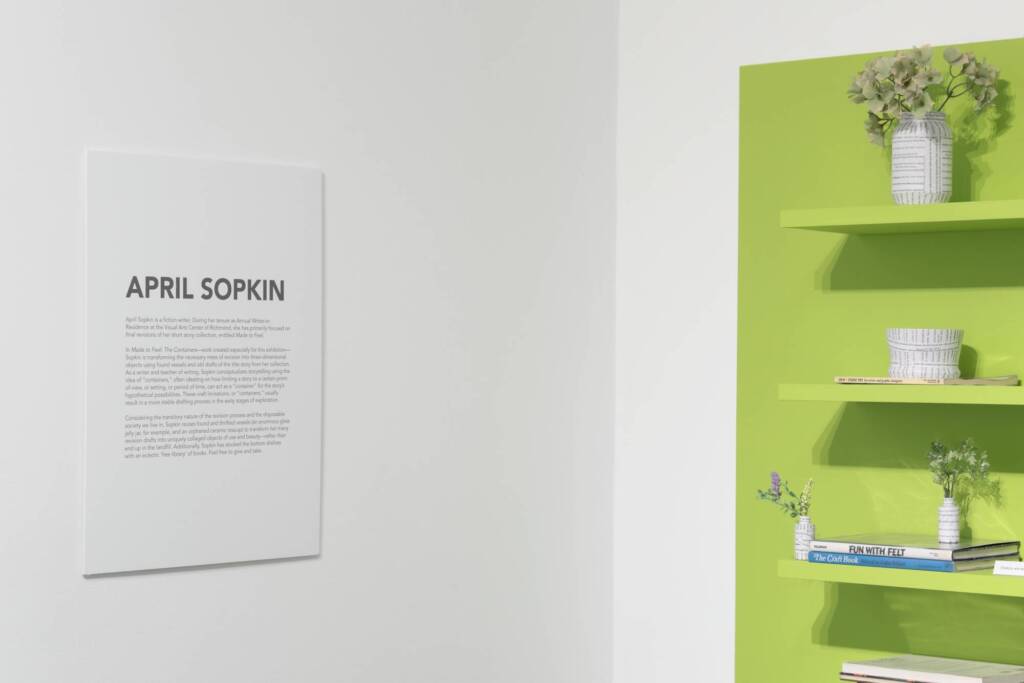
“What We Share” on view in the True F. Luck Gallery, May 2025
Last but not least: Are there any fun memories that stand out to you during your residency?
From my studio, I hear a lot of what the classes are doing across the hall, and there’s so many art classes for little kids happening. I hear a lot of running in the hall, a lot of exclamations, all that stuff. It’s just really delightful to be in here working on something incredibly serious, a very literary story, and then across the hall, you just have all these kids painting and having fun. It’s nice that my experience doesn’t feel like siloed from the rest of VisArts by any means—that it feels very much like it’s just another part of the whole apparatus.
Learn more about residencies at the Visual Arts Center of Richmond.
Interests and opinions expressed by artists-in-residence are their own. Learn more about VisArts’ organizational values and code of conduct.