Blog
Artist Spotlight: Jake Lahah
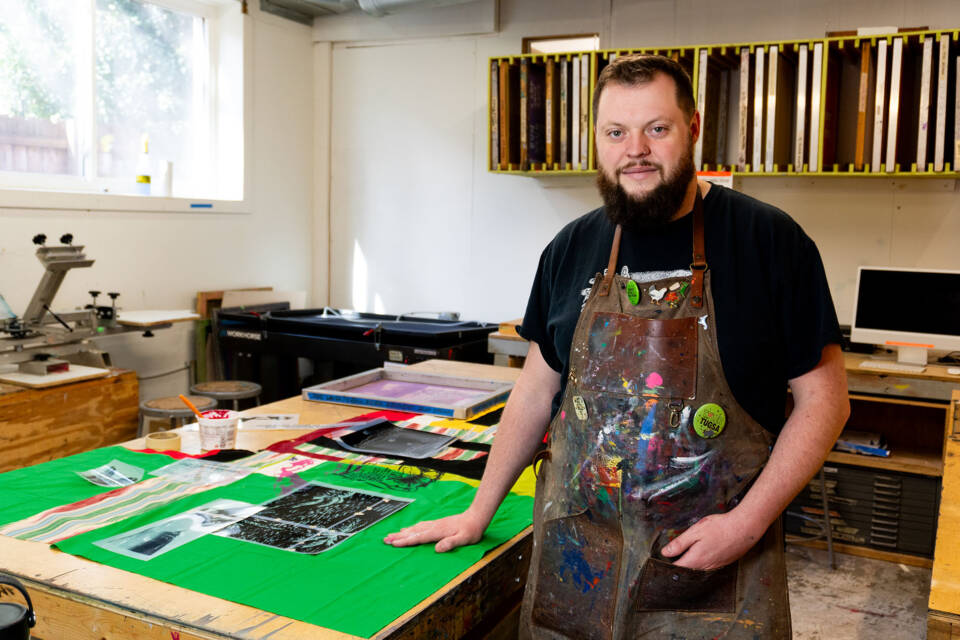 Jake Lahah (he/him) is one of VisArts’ Studio Access Artists-in-Residence in the Fall/Winter 2025-2026 cohort.
Born in Wildwood, NJ, living and working in Richmond, VA, Jake is an artist, researcher, and educator whose work examines topics on labor, queerness, and ecology. His work considers how visual culture and data are testimony of the human condition through installation, print media, and craft-making methodologies.
In our conversation with him partway through his residency, Jake provided insight into his creative practice that spans multiple media, and how his research into queer history, his childhood on the Jersey Shore, and his ability to weave together multiple media provide the foundation for his work.
VisArts: How would you describe yourself as an artist?
Jake: I’m a Richmond-based artist and researcher. My formal training is in printmaking practices, but I consider myself to be an anti/inter/transdisciplinary artist that also works with craft mediums such as sculpture, fiber, glass, and installation. I have a project-based practice that focuses on work about queer histories, labor, politics, ecosystems, and public narratives.
What was your first interaction with VisArts?
The first time I stepped foot into VisArts was in 2017 when Carli Holcomb’s exhibition After Dark premiered. I came to VisArts to specifically see her work and her expanded practice with metals.
I still think about that show from time to time, specifically how it was installed and how it integrated the unique layout of VisArts exhibition space.
This residency is the first time I am working in VisArts’ spaces, and it’s been an absolute joy to meet so many different artists. I hope to continue making work here and staying in touch with the community I’ve learned so much from when it’s over.
 What are you working on during your residency?
Part of my research-based practice is centered around archival research on queer outreach organizations. I teach at ODU two days a week and am looking through the archives of Our Own Press1, a queer-centered newspaper that operated in Norfolk during the 80s and 90s. The newspaper highlighted queer stories in Virginia and reported critical updates on the AIDS crisis.
I’m also doing research in the VCU Special Collections, specifically with the Fan Free Clinic archives2. The Fan Free Clinic was a Richmond based health clinic that strongly focused on HIV-prevention and treatment within the city.
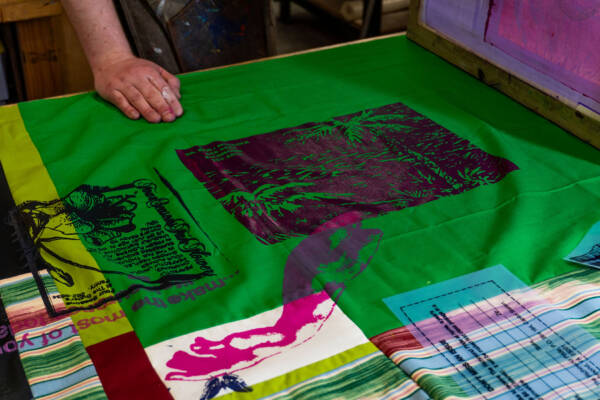
With the VisArts residency, I’ve been taking my research to the studio, working collaboratively in the printmaking and fiber studios. I’ve been sewing these piecework fabric pieces that I screenprint images and textual information from the archives onto. They then get stretched into “paintings” that I respond to gesturally with acrylic paint and other ephemeral media.
With the skill shares the Studio Access Residents are doing, I also get to jump into other craft media that I’m unfamiliar with. I’ve been dabbling with ceramics in my downtime, trying to figure out how it fits within my research-based works.
 How were you drawn to the media you work in?
I try really hard to think about the material poetics of the work I make. I did my MFA at Tyler School of Art + Architecture, which is a wildly interdisciplinary program. There, I learned pretty quickly that paper as a material limited the concepts I was interested in exploring. As a print person, I’m always thinking about the combination of image and substrate as a marriage that holds a narrative that correlates to my research.
Fiber art and its history are huge components of my work. They have deep roots in feminism and queer activism, and are a reflection of the activist qualities of my archival research. There are also subtle nods to the AIDS quilt3 and protest banners within my work.
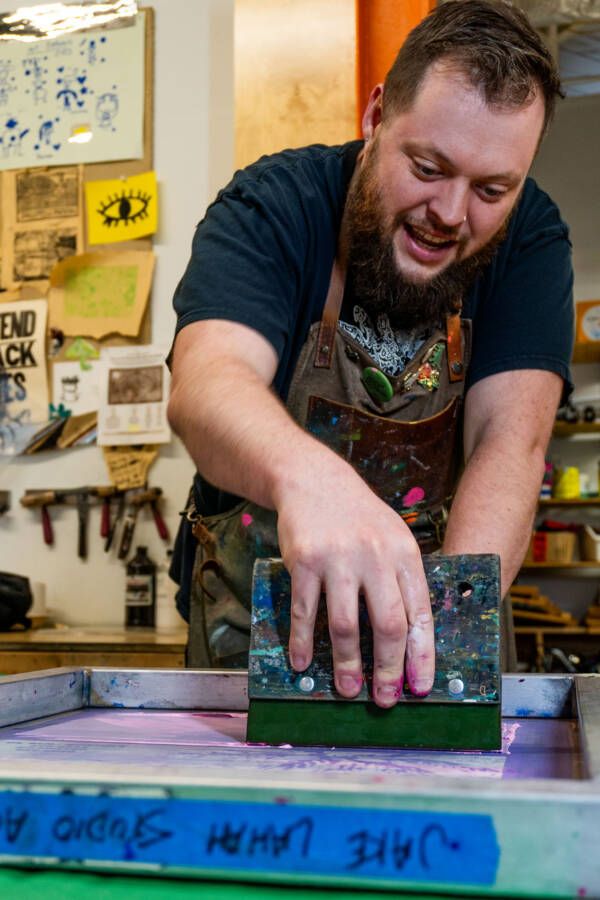
My favorite printmaking process is screenprinting, a practice that poses many conceptual challenges that acts as a driving force in the studio. When working with digital or scanned files, you have to distill it down to its essence. Each layer is printed as a single color, so there are informed decisions about what color to print things. Screenprinting itself has a strange history of being marginalized within the history of traditional printmaking processes as well. There’s always this balance between how information is lost and recontextualized through the practice. I look for ways that queer and print histories are parallel.
What are some of your sources of inspiration?
While a majority of the work I currently do responds to archival and textual data analysis, I’m always inspired by places that have a strong visual language.
I grew up on the Jersey Shore with family in the Cape May/Wildwood area. Wildwood, NJ is like the Disneyland of east coast beach towns. The town was developed with the intention of providing a Doo-Wop/Vegas like vacation experience for working class families that couldn’t afford to take extravagant trips to the Caribbean or Florida beaches. There’s tons of tacky tourist shops and neon lights when walking the boardwalk–things that capture your attention in the mix of unruly patrons.
Whenever I go back, I practice the “slow looking”4 that artists inherently do when navigating the world. I think my observations on the political signs, the tourist-trap-like custom shirts, and the labor and social politics of the site gave me critical tools that inform the way I approach my research-based projects.
What are you hoping to communicate to the viewer?
I want my viewers to ultimately re-think the ways images are transmitted and upheld in our culture, deconstructing how they become symbols of abstract thought, politicized in plain sight. I’m often pulling from advertisements, headlines, and news sources—sites of information that are considered “neutral” within public narratives—in a way that remixes content with color, materials, and relationality.
I hope that my viewer sees how layered queer histories actually are, and that abstraction, formalism, and gesture can be tools to help unpack the political from the seemingly banal.
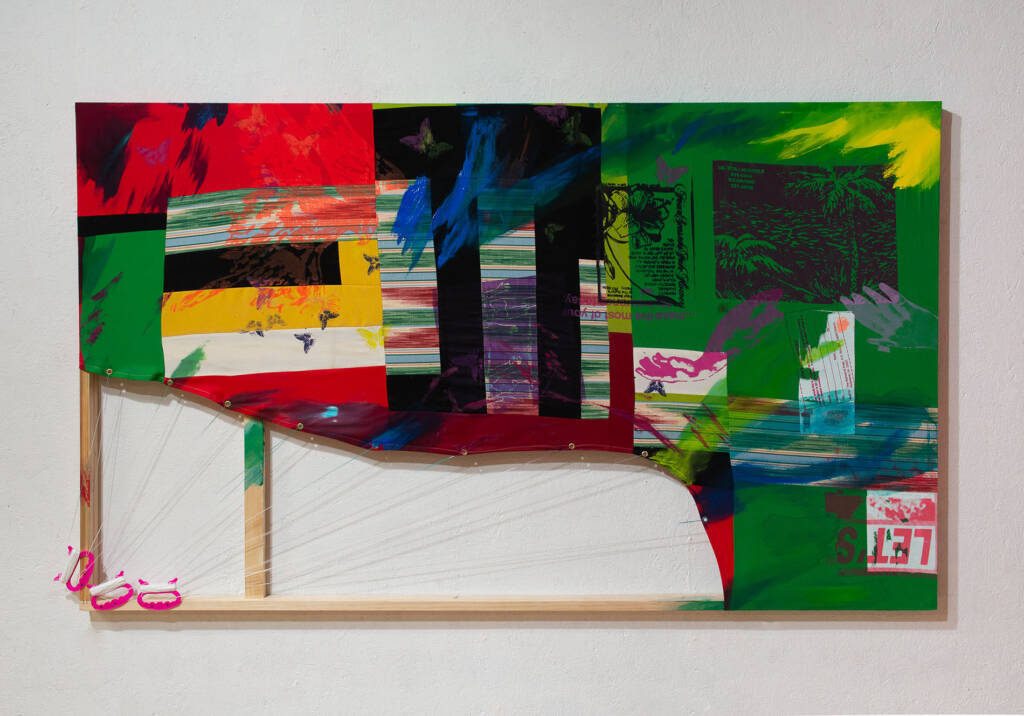
The finished piece that Jake can be seen working on in the previous photos is titled “Tethered.”
Jake received a BFA from George Mason University (2017) and an MFA in Print from Tyler School of Art + Architecture at Temple University (2024). While at Temple University, he was a Project Completion Grant Fellow to aid in his research on the history of the palm tree as a symbol of utopia.
Lahah is a Gay Cultural Studies Creative Research Grant recipient within the department Women and Gender Studies at Old Dominion University, where he recently created a body of work exploring the connections between the AIDS crisis and silica mining industries.
Notable places Lahah has shown include: Bond Millen Gallery, Richmond, VA; ADA Gallery, Richmond, VA; Temple Contemporary, Philadelphia, PA; Vox Populi, Philadelphia, PA; IA&A at Hillyer, Washington, D.C.; ICA Baltimore, Baltimore, MD; and Skylab Gallery, Columbus, OH.
He is currently an Assistant Adjunct Professor within the Foundations and Drawing/Painting Department at Old Dominion University.
Learn more about Jake + his work: Instagram: @jakelahah | Website: jakelahah.com
1 “Collection: Our Own Community Press Newspapers.” Old Dominion University, ODU Libraries, archivesguides.lib.odu.edu/repositories/5/resources/47. Accessed 1 Apr. 2026.
2 “Collection: Fan Free Clinic Records.” Virginia Commonwealth University, VCU Libraries, archives.library.vcu.edu/repositories/5/resources/160. Accessed 1 Apr. 2026.
3 Machemer, Theresa. “You Can Now Explore All 48,000 Panels of the AIDS Memorial Quilt Online.” Smithsonian Magazine, 21 July 2020, www.smithsonianmag.com/smart-news/aids-memorial-quilt-now-online-180975370/.
4 “A guide to slow looking.” Tate. Accessed 1 Apr. 2026. www.tate.org.uk/art/guide-slow-looking