Blog
A conversation with Artist-in-Residence, Doah Lee

Doah Lee (she/her) is one of Visual Arts Center of Richmond’s Annual Residents. Doah is a mixed-media visual artist originally from Korea. Her practice spans a range of media, including drawing, painting, printmaking, textiles, and installation.
Nearing the end of her residency, we caught up with Doah in her studio to learn more about her practice and her experience here at VisArts.
VisArts: Doah, tell us about your creative practice. What concepts do you explore in your work?
Doah: Through my work, I explore themes of cultural translation, immigration, feelings of otherness, and femininity. I reflect on my experiences living in the U.S. as a foreigner. I’m particularly interested in the process of self-identification across two distinct cultural spaces as it relates to race and gender. My curiosity lies in how individuals, especially children, form their identity under cultural and socio-political pressures, and how these forces shape their perception of the world. I’m also deeply interested in the early childhood education and its role in constructing our understanding of identity and experience.
What’s one of your earliest memories of creating something?
I always loved drawing, ever since I was very little. My mom sent me to an arts center, kind of like VisArts, where I took some art classes. I remember trying to draw my house, and the teacher showing me how to use a rectangle for the building and a triangle for the roof. I remember thinking “that’s not my house” because I lived in an apartment building. She also showed me how to draw clouds and stars, but when I would look up at the sky, they didn’t look like what she showed me to draw. I was confused.
I still remember looking up at the sky and thinking about the differences between what I could see and what I was taught to draw. I think that memory drives me to question people’s perception of the world: Is what people see truly there, or is it something constructed in their minds? This memory inspired me to explore these themes and draw a lot of childhood landscapes as symbolic images in my work.
What have you been working on during your time here?
I’ve been making a range of artwork since I started my VisArts residency. One of the main projects that I’ve been developing is a drawing series created with a crayon, the kind that many of us grew up using.
I started by drawing large, empty landscapes, mostly using green and blue tones. Then I covered the entire surface with a black crayon, and using a fork I scratched through the black layer to reveal the fragments of the landscape underneath. I taped these drawings together to form one large sheet of paper, and then folded them into origami paper boats, and then unfold them again. Using a knife, I then scratched along the creases, marking them as a symbolic tracing, kind of echoing the immigrant journey in this land.
The idea behind this work started during my residency at VisArts. I’ve been driving frequently between Richmond and Penn State University [where Doah is currently an assistant professor]. On the drives, I watched as long stretches of highway passed through vast, empty land. It made me reflect on the idea of land, particularly in the context of The American Dream. I have begun to think more critically about who is truly allowed access to The American Dream, who gets to occupy the space, and who owns it.
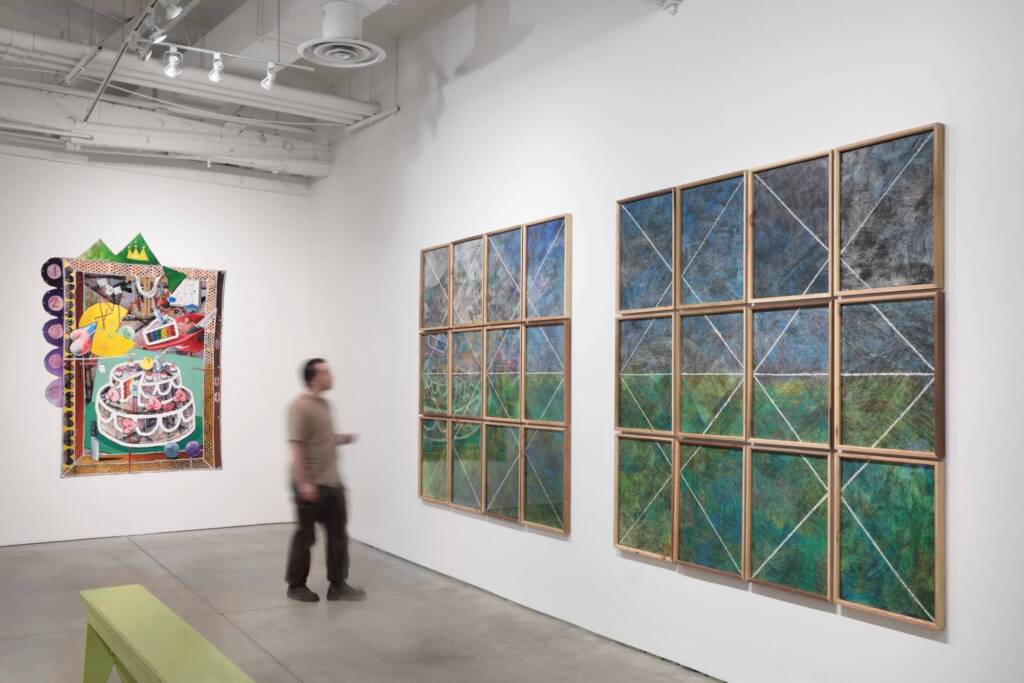
“What We Share” on view in the True F. Luck Gallery, May 2025
How has your residency at VisArts impacted your practice?
VisArts offers a wide range of the studio space and classes which has allowed me to explore outside of my comfort zone. I took classes in ceramics, stained glass, and even 3D printing. I’m not sure yet how this will fit into my long-term practice, but these experiences have expanded my understanding of all these different media, materials, and techniques.
What do you want people to take away after experiencing your work?
I hope viewers can connect with the storytelling of my work by engaging with it and gaining an understanding and appreciation of a different perspective. I believe that’s how we begin to build community together.
Interests and opinions expressed by artists-in-residence are their own. Learn more about VisArts’ organizational values and code of conduct.