Blog
Artist Spotlight: Aaron Uzzle
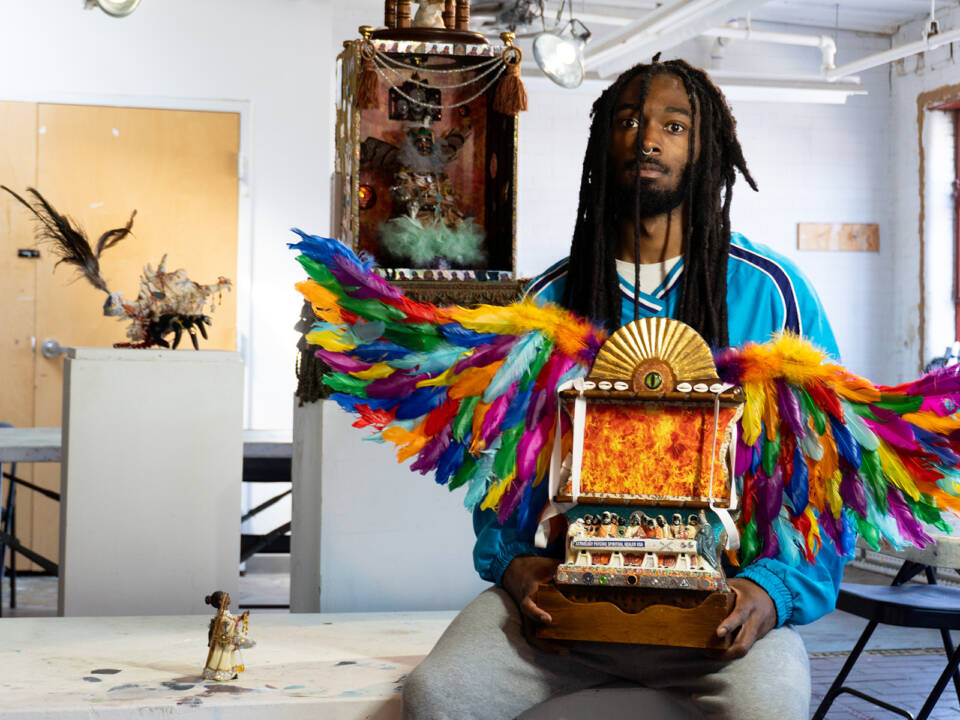 Aaron Uzzle (he/him) is one of the Visual Arts Center of Richmond’s Fall/Winter 2025–2026 Studio Access Residents.
Aaron is a Virginia-born artist who’s conjured expressive, mysterious works for almost a decade. He understood art as a tool for communicating complex feelings and ideas from an early age. Uzzle’s dedication to the craft is unbounded in both practice and study. His decision to pursue art as a profession after graduating high school was inevitable; a response to a spiritual calling.
Uzzle’s concern with expression was initially explored through stylized representation, painting experimental portraits of Black subjects with distorted forms in otherworldly realms. Intertwining West African and Black Atlantic traditions in his practice led Uzzle to abandon painting altogether in favor of mask-making, sculpture, and, currently, assemblage. The act of combining various real-world elements into a new form expands Uzzle’s capacity for creativity into limitless possibilities; infusing a host of questions, responses, and intentions regarding the material and spiritual world simultaneously into each piece. This culminates in glistening monuments that are enigmatic, multidimensional, decidedly Black, and deeply personal.
Partway through Aaron’s residency, we caught up with him to learn more about his creative practice in assemblage, his influences from the African Diaspora, and what he’s been working on during his six-month residency.
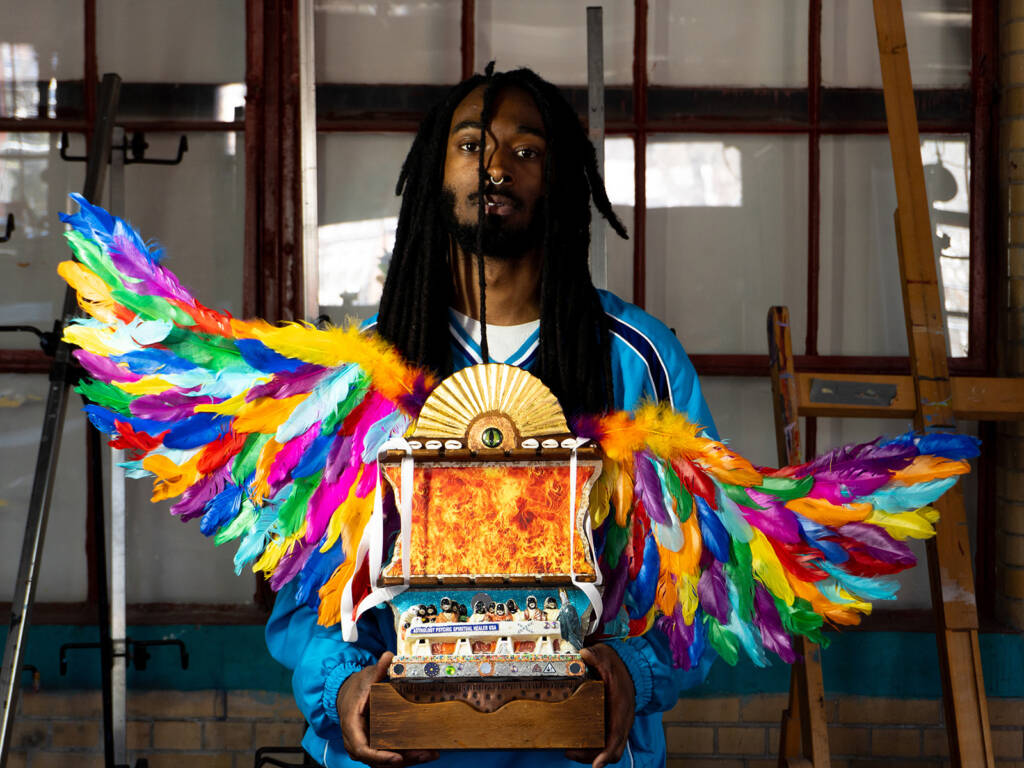
Aaron with an in-progress assemblage piece.
VisArts: How would you describe yourself as an artist?
Aaron: I’m currently a mixed-media artist working in assemblage1. More than just art, each work is a monument of self-empowerment and expression, a form of therapy and catharsis, and a reconnection to lost ancestry. They’re portals to higher planes and new possibilities. Assemblage is only the medium through which these forces speak.
What was your first interaction with VisArts?
My first true interaction with VisArts is through this residency. When I went to VCU, I walked by the building frequently but had only been inside once or twice.
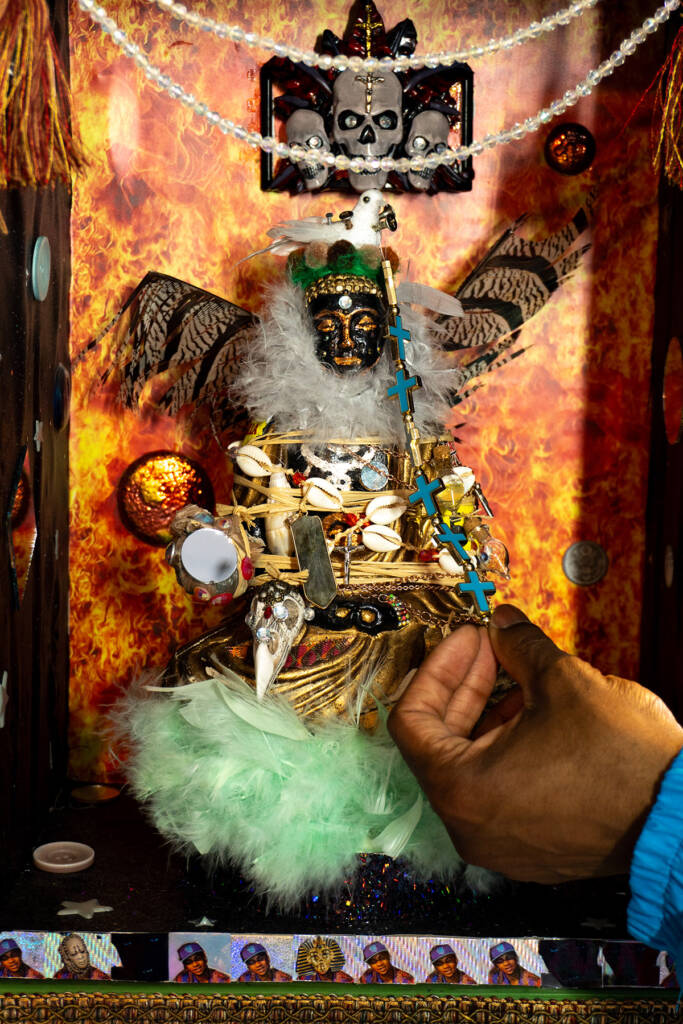
A close-up of one of Aaron’s works.
What are you working on during your residency?
I have used the space to expand my practice: working on larger projects that I would otherwise have to cram in my apartment, and discovering tools I never knew I needed, like the guillotine paper cutter. I created my most ambitious piece to date because of the access to that additional space.
I took the time to catch up on some books, too. Studying is half the practice, but staying consistent isn’t always easy. My reading accelerated and I was actually able to absorb the information. I ended up knocking out a textbook I’ve been procrastinating on for a year in a half. The relief was indescribable.
Artist development has been a priority as well. I’ve gotten insight into areas of my career outside of art-making that I can improve on. Describing my practice and presenting it to others have been challenges I’m finally overcoming thanks to experiences in this residency.
How were you drawn to the media you work in?
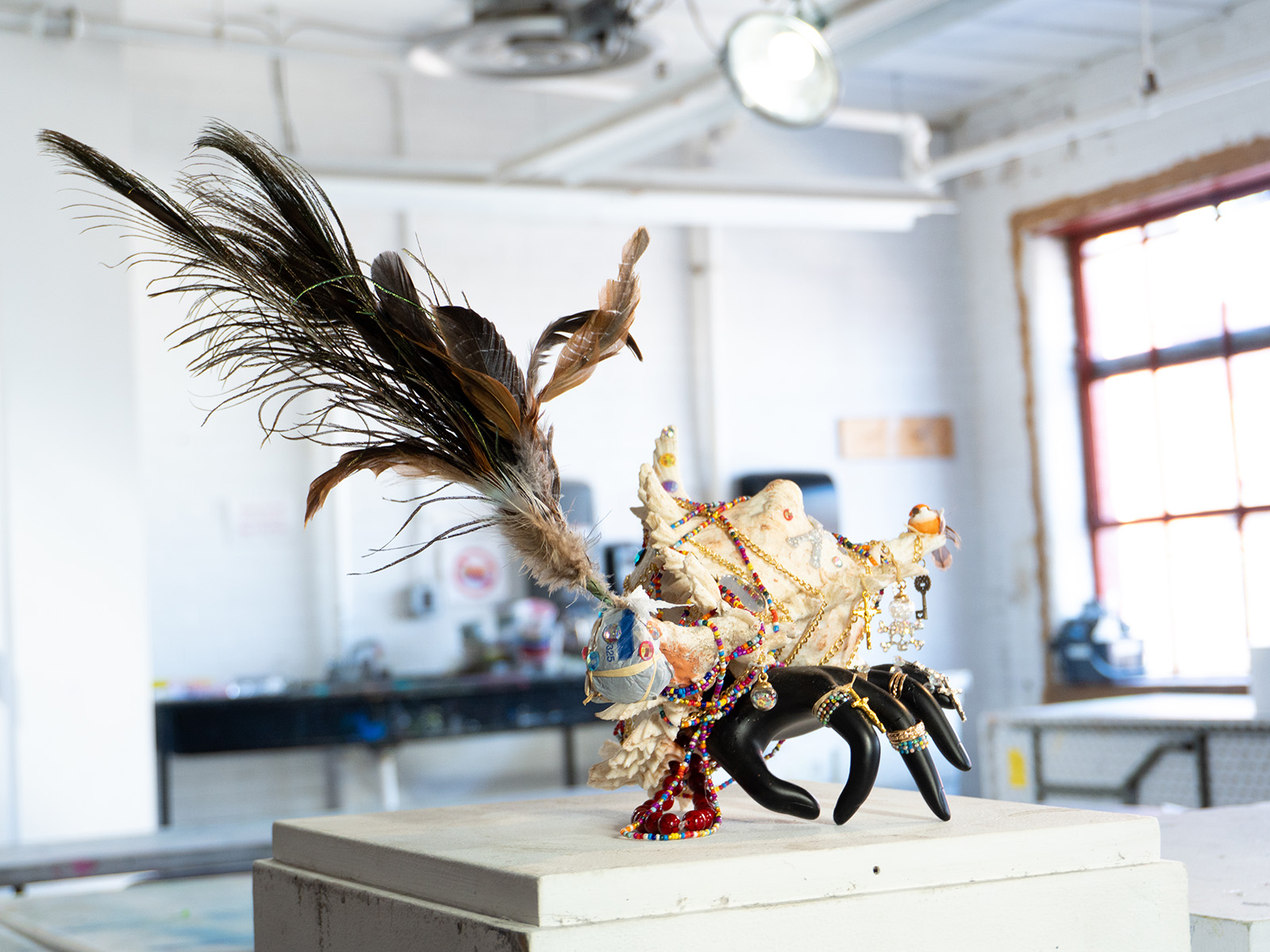
Assemblage brings out my best strengths as an artist. It allows my intuition to fully guide the way in art production. When I have a vision for a piece, the materials call to me, whether they’re lying around in my apartment or waiting for me at the thrift store. The assembling process is just as instinctive. I’m able to improvise and feel my way to a finished work. It’s most accessible for me and allows adaptation compared to other mediums.
I love being able to curate the real-world around me. This is what my practice was meant to be.
What are some of your sources of inspiration?
They range from visual art, music, religion, and mysticism all across the Black Diaspora. Artists Betye Saar2 and Pierrot Barra3 have the biggest influence on me as an assemblage artist. The Mardi Gras Indian tradition4 employs art/performance as personal expression, an homage to ancestors and resistance to oppressive forces. Standing on the Corner is a contemporary band that blends aspects of virtually every Black genre into dreamy, experimental sound collages. Hip-hop in general was born as a fusion of disco, funk, soul, etc. Afro-Diasporic religions maintained their ties to their homeland under horrific conditions while still developing their own distinct cultures. All these things that move me carry that assemblage energy.
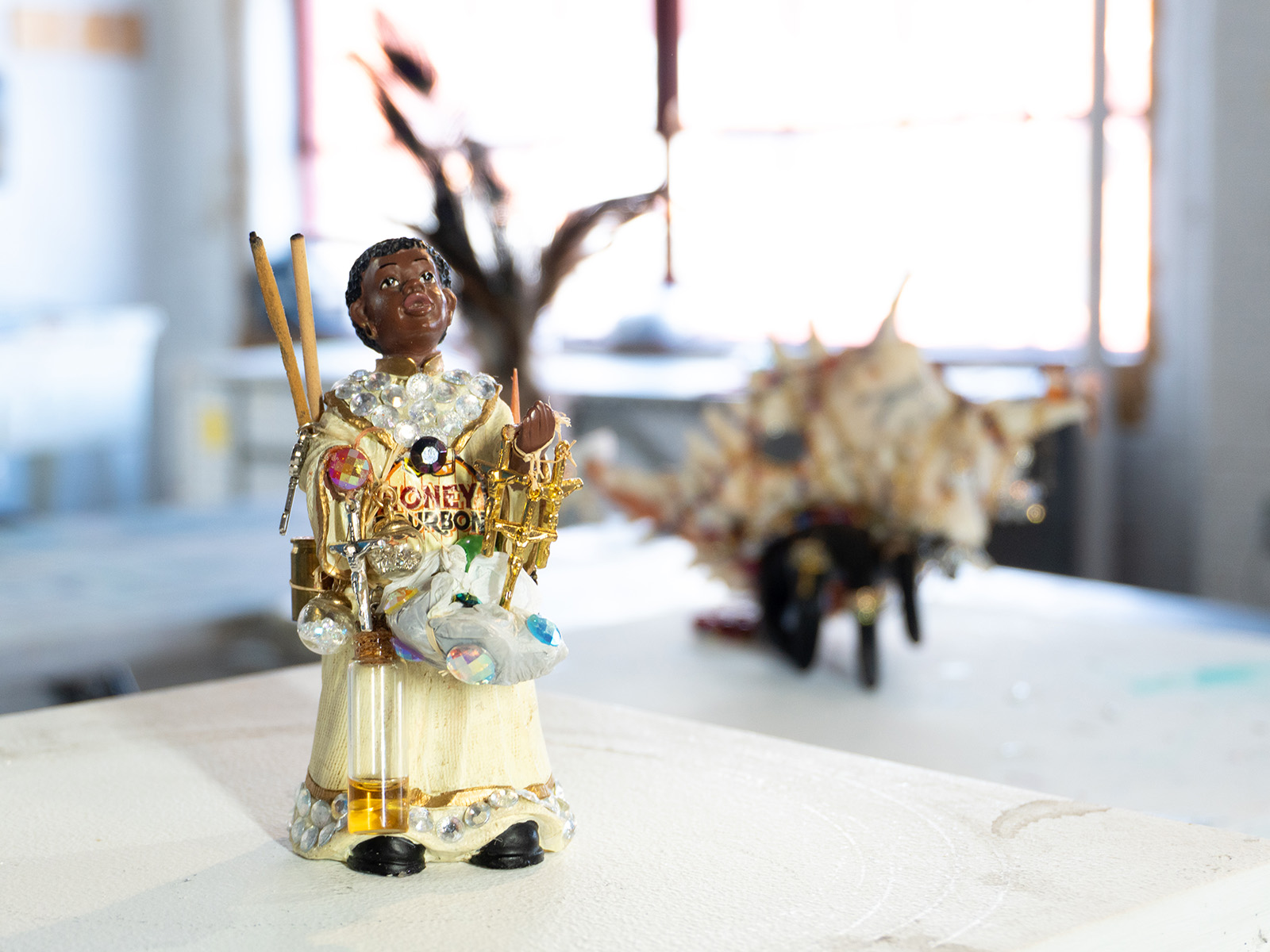
What are you hoping to communicate to the viewer?
I want the viewer to see what I see. I feel things on an intense level but learned to mask that part of me from the outside world. Art is where my true self is revealed, where I communicate complex feelings and thoughts that I otherwise keep to myself. I want the viewer to experience my fears, pain, grief but also my joy, triumph, and desires.
Each piece has a lot going on because I have a lot to say. I want the viewer to believe in their power. Like I mentioned before, my art inhabits forces from a higher realm. I talk to my works and they talk back. Different worlds do exist.
—
Uzzle has a degree in Creative Advertising from Virginia Commonwealth University. He is self-taught, having received minimal art education through art history electives and a non-major painting class. Since 2019, his work has been published and exhibited in various venues, including exhibitions, murals, and public events, throughout Virginia.
Uzzle primarily works in mixed media but is also experienced in clay, oil, acrylic paints, pastels, and Adobe Suite. He is based in Richmond, Virginia.
Learn more about Aaron + his work: Instagram: @moseshorns / Website: aaronuzzle.com
Interests and opinions expressed by artists-in-residence are their own. Learn more about VisArts’ organizational values and code of conduct.
1 “Assemblage | MoMA,” MoMA.org, accessed March 10, 2026, https://www.moma.org/collection/terms/assemblage
2 “Betye Saar.” Hamner Museum. Accessed March 10, 2026. https://hammer.ucla.edu/now-dig-this/artists/betye-saar
3 “Pierrot Barra.” Myriam Nader Art Gallery. Accessed March 10, 2026. https://www.naderhaitianart.com/collections/pierrot-barra-haitian-1942-1999
4 “Mardi Gras (Black Masking) Indians.” New Orleans & Company. Accessed March 10, 2026. https://www.neworleans.com/things-to-do/music/history-and-traditions/mardi-gras-indians/